
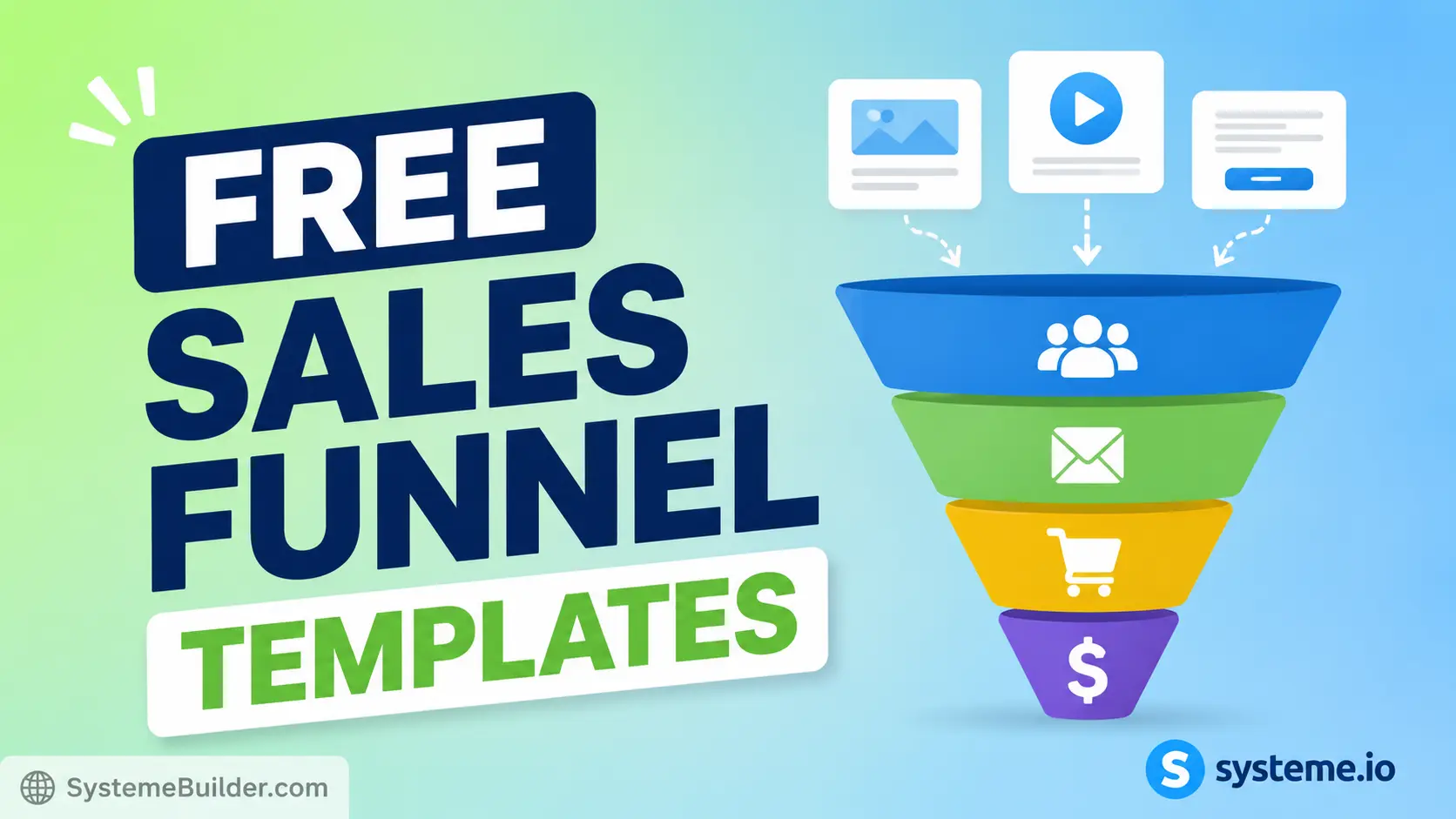
If you want free sales funnel templates you can actually launch today, the fastest path is a free funnel builder with ready-made templates built in — no design skills and no credit card required.
You don’t need to build a funnel from scratch.
The proven structures already exist as templates: a squeeze page here, a thank-you page there, a checkout, a follow-up sequence.
Your job is just to swap in your offer and publish.
This guide covers the main types of free sales funnel templates, where to get them, and how to launch one in minutes — plus the design rules that decide whether a template converts at 20% or flops at 2%.
What is a sales funnel template?
A sales funnel template is a pre-built set of connected pages designed to move a visitor toward one goal.
That goal might be joining your email list, buying a low-ticket product, or registering for a webinar.
Each template includes the page layouts, the flow between steps, and often a starter email sequence.
Instead of designing from a blank canvas, you customize a structure that’s already proven to convert.
For the bigger picture on how these pieces fit together, see our how to build a sales funnel guide.
The main types of free sales funnel templates
Almost every funnel is a variation of a few core structures.
Here are the ones worth knowing — and what each is for.
1. Lead magnet (squeeze) funnel
This is the most common starting point.
You offer something free — a checklist, ebook, or mini-course — in exchange for an email address.
The structure is simple: a squeeze page, a thank-you page, and a short welcome email sequence.
Our high-converting lead magnet funnel guide breaks down exactly how to make one work.
2. Tripwire funnel
A tripwire funnel sells a low-ticket offer, usually $7–$47, right after someone opts in.
The goal isn’t big profit — it’s turning a subscriber into a buyer, which dramatically improves future sales.
It typically adds an order bump and a one-click upsell to the basic structure.
3. Sales (core offer) funnel
This funnel sells your main product, often $100 and up.
It usually includes a sales page, a checkout with an order bump, and an upsell or downsell sequence.
This is where most of your revenue comes from once the funnel is warmed up.
4. Webinar funnel
A webinar funnel registers people for a live or evergreen presentation, then sells at the end.
The flow is: registration page, confirmation, the webinar itself, a replay page, and a sales page.
It’s powerful for higher-priced offers that need more trust before purchase.
5. Product launch and membership funnels
Launch funnels build anticipation over several days before a cart opens.
Membership funnels sell access to gated content or a community on a recurring basis.
Both are variations of the core structures above, just sequenced differently.
For more on choosing the right structure, our funnel strategies for beginners guide is a good next read.
Where to get free sales funnel templates
You’ll find free templates in a few places, but they vary wildly in quality and usability.
Free funnel builders with built-in templates are the best option, because the template is already wired up and ready to publish.
Creator freebies (a designer’s free template in exchange for your email) can be good, but you still need a platform to host them.
Marketplaces like Etsy sell template packs, but those usually cost money and still require a builder.
The simplest route is a platform that gives you both the templates and the tools to launch them — for free.
That’s where Systeme.io stands out.
The easiest way: Systeme.io’s free plan
Systeme.io includes ready-made templates for the most common funnel types — lead magnet, tripwire, product launch, webinar registration, and membership — each with pre-built page designs and starter automation.
The best part: you get 3 full funnels for free, with no credit card and no expiry.
Most competitors charge $97/month just for the funnel builder, so getting professional templates and the platform at zero cost is rare.
You can browse the brand’s full template library in our Systeme.io templates overview, and learn the exact build process in our how to create a funnel in Systeme.io tutorial.
Start free: Create your free Systeme.io account here and get instant access to ready-made funnel templates — no card required.
How to launch a free template in minutes
Once you’re inside a builder like Systeme.io, going live is quick.
- Open Funnels and click Create a funnel.
- Choose your goal — build an audience, sell a product, or run a webinar.
- Pick a template for that funnel type.
- Click each step to edit text, images, and your offer in the drag-and-drop editor.
- Connect your payment processor on the checkout step (if you’re selling).
- Publish and share your funnel link.
Most people have a live funnel within an hour of signing up.
You can do all of this on the Systeme.io free plan and upgrade later only if you need more.
Pair your funnel with a simple welcome sequence — our email marketing for beginners guide shows you how — and start building free here whenever you’re ready.
What makes a free template actually convert
A template is only as good as how you use it.
Two funnels can use the same template and convert at wildly different rates.
Here’s what separates the winners.
One page, one job. Your squeeze page should have a single headline, one image, and one CTA — nothing else to distract.
Promise a specific outcome. “Get the 5-step framework that books 12 meetings a week” beats “Improve your outreach” every time.
Show the deliverable. A mockup of the PDF, checklist, or course makes the free offer feel real.
Write action CTAs. “Send me the framework” converts better than a generic “Submit.”
Add social proof. Testimonials, reviews, and trust badges reduce hesitation right before the click.
Design mobile-first. Most traffic is mobile, so check that your template looks clean on a phone.
Common mistakes to avoid
A few errors quietly kill conversions.
Cramming too much onto one page. More options means more hesitation. Less is more.
Skipping the follow-up sequence. The template’s emails matter as much as the pages — set them up.
Forgetting mobile. A template that looks great on desktop can fall apart on a phone.
Trying to do too much on the free plan. Systeme.io’s free plan allows one automation and one tag, so a full lead-magnet-plus-tripwire flow can hit that limit. For free, focus on a single goal first, then upgrade when you’re ready to layer in more.
FAQ: Free sales funnel templates
Where can I get free sales funnel templates? The easiest source is a free funnel builder with templates built in, like Systeme.io, which gives you ready-made templates and three free funnels with no credit card.
Are free funnel templates good enough to convert? Yes — proven templates handle the structure, and conversion comes down to your headline, offer, single CTA, social proof, and mobile design.
What types of sales funnel templates are there? The core types are lead magnet (squeeze), tripwire, sales/core offer, webinar, product launch, and membership funnels. Most other funnels are variations of these.
Do I need to pay to use funnel templates? No. Systeme.io’s free plan includes templates and three full funnels at no cost. You only pay if you need more funnels, contacts, or advanced automation.
How fast can I launch a funnel from a template? Most beginners have a live funnel within an hour: choose a template, edit the pages, connect payments if needed, and publish.
What’s the best free funnel template for beginners? Start with a lead magnet (squeeze) funnel. It’s the simplest, builds your email list, and sets up every funnel you’ll create later. See our best free funnel builders comparison for platform options.
Stop staring at a blank page — grab a proven structure instead. Create your free Systeme.io account, pick a ready-made template, and launch your first free sales funnel template today. You can view the official template options on the Systeme.io sales funnels page.
Affiliate disclosure: some links on this page are affiliate links. If you sign up through them, we may earn a commission at no extra cost to you. We only recommend tools we believe genuinely help our readers.